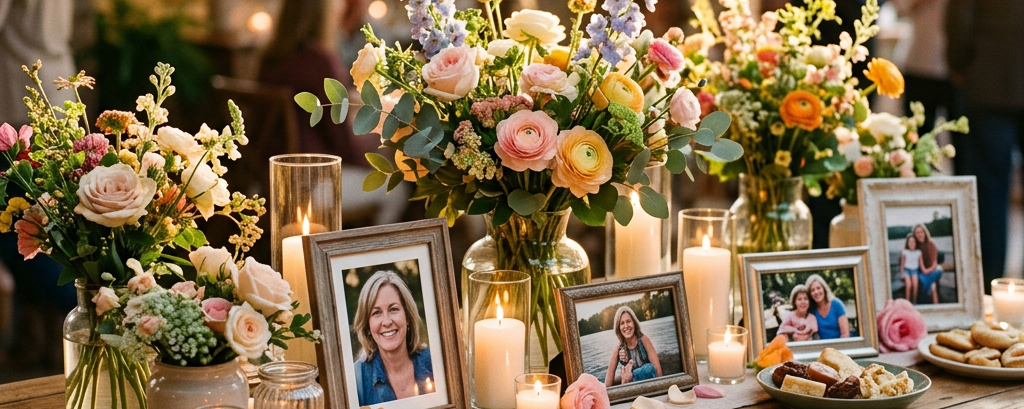
The lilies were beautiful, and completely wrong. Every funeral home default — white flowers, muted tones, formal arrangements — sat in the rented hall looking like a stage set for someone else’s grandmother, not the woman who’d worn turquoise every single day for forty years and would have hated, specifically and vocally, being surrounded by beige. Her daughter swapped the lilies for sunflowers and a table of her mother’s actual turquoise jewelry within an hour of walking in, and the room instantly felt like it belonged to the right person again.
That’s the core principle behind decorating a celebration of life well: the default aesthetic of a traditional funeral is built for solemnity in general, not for a specific person. Decorating with intention means asking what actually represented this person, not what a florist’s default catalog assumes a memorial should look like.
Color Is the Fastest Way to Make a Room Feel Like Them
If the person had a signature color, a favorite team, a beloved sports jersey color, or simply a palette they surrounded themselves with, building the space around that instead of traditional black or white does more emotional work than almost any other single decision. A room full of a favorite bright color reads immediately as “this celebrates a specific person,” where a room in traditional funeral tones reads as “this could be anyone’s memorial.”
Display the Things They Actually Touched
Beyond photographs, which are expected and valuable, consider displaying actual objects that carried the person’s presence — a well-worn tool, a favorite mug, a piece of clothing, a hobby’s equipment. These tend to land harder than photos alone, because a photograph shows what someone looked like, while a physical object they used regularly carries a trace of what it was actually like to be near them. A woodworker’s actual chisels on a table often say more than any picture of him using them.
Let the Food and Music Do Some of the Talking
Decoration isn’t only visual. A favorite recipe served at the gathering, a playlist of music the person actually loved rather than generic memorial music, or a specific drink they were known for making — these are decorations for the senses beyond sight, and they’re often the details people remember and talk about longest afterward. A celebration of life that sounds and tastes like the person, not just one that looks respectful, tends to feel more complete.
Give Guests a Way to Add Their Own Piece
A guest book is traditional and often underused emotionally. Consider instead a memory table where guests can leave a small written note, a photo, or an object of their own that connects to the person, building the display collectively over the course of the gathering rather than presenting a finished, static arrangement. This gives people something active to do with their grief in the moment, rather than sitting with it passively, and it often produces the most unexpectedly moving contributions of the whole event.
The room with the sunflowers and the turquoise jewelry didn’t look like a traditional memorial. Several guests said, afterward, that it was the first funeral-adjacent gathering they’d ever been to that actually looked like the person being remembered. That was the whole goal, and it turned out to matter more than any arrangement a florist’s catalog could have offered by default.