
(Enroll for just $197, or Included With Your All Access Pass)

When you leave your final arrangements to for others to decide after you’re gone, you’re leaving behind a complex maze of decisions for others to make on your behalf. In this opening module, we will address the reality of “at-need” funeral planning and the overwhelming burden it places on grieving loved ones.
You’ll learn exactly what happens in those first few days after someone passes, and how pre-need planning can free your family to focus on grieving and supporting one another, rather than dealing with the stress of final decisions.

Funerals are not one-size-fits-all events. The service should both reflect and honor your individual life, representing you uniquely. In this deeply personal module, we’ll move beyond the logistics and focus on the legacy you want to leave behind.
You will learn how to weave your unique personality, traditions, and values into your final arrangements, ensuring that your family’s memory of you is a true celebration of the life you lived.

Most people don’t realize how much control they have over their final arrangements until it is too late. In this module, we’ll demystify and walk you through your specific choices for disposition, service levels, and the funding vehicles that make them possible. Whether you want a traditional burial or a simple cremation, you will gain the knowledge needed to make educated decisions.

When we think about our physical remains, we often only think about the first generation—our spouse or children. But what happens to your remains when they pass away? In this module, we tackle the crucial but often-overlooked question of permanent memorialization.
You will learn how to make decisions today about what you would like to have done with your physical remains once they pass beyond the next generation. This is important to avoid grandchildren and or great grandchildren from feeling conflicted about what you would have wanted.
A pre-need plan is only as reliable as the funding behind it. In this critical module, we tackle the most common question in pre-need planning: How much is this going to cost, and how do I pay for it? We will walk you step by step through a process for estimating funeral expenses in your local market and how you can ensure that your family isn’t left having to cover the immediate expenses out of pocket, or worse, with credit cards.

In this module, we will bridge the gap between planning and execution. You will learn how to properly document your wishes, legally authorize your decisions, and most importantly, how to have the sometimes difficult but necessary conversation with your children so they know where to find everything, who to contact, and exactly what to do when the time comes.

In our final and most comprehensive module, we tackle the practical execution of your plan and address each of the common myths that keep families from pre planning. You will learn practical tips for how best to leave behind meaningful personal messages, allocate heirlooms without causing family fighting, and navigate the arrangement conference with a funeral provider. We will also break down the exact timeline of tasks your family will need to handle after you are gone so everyone knows well in advance what must be done and when.
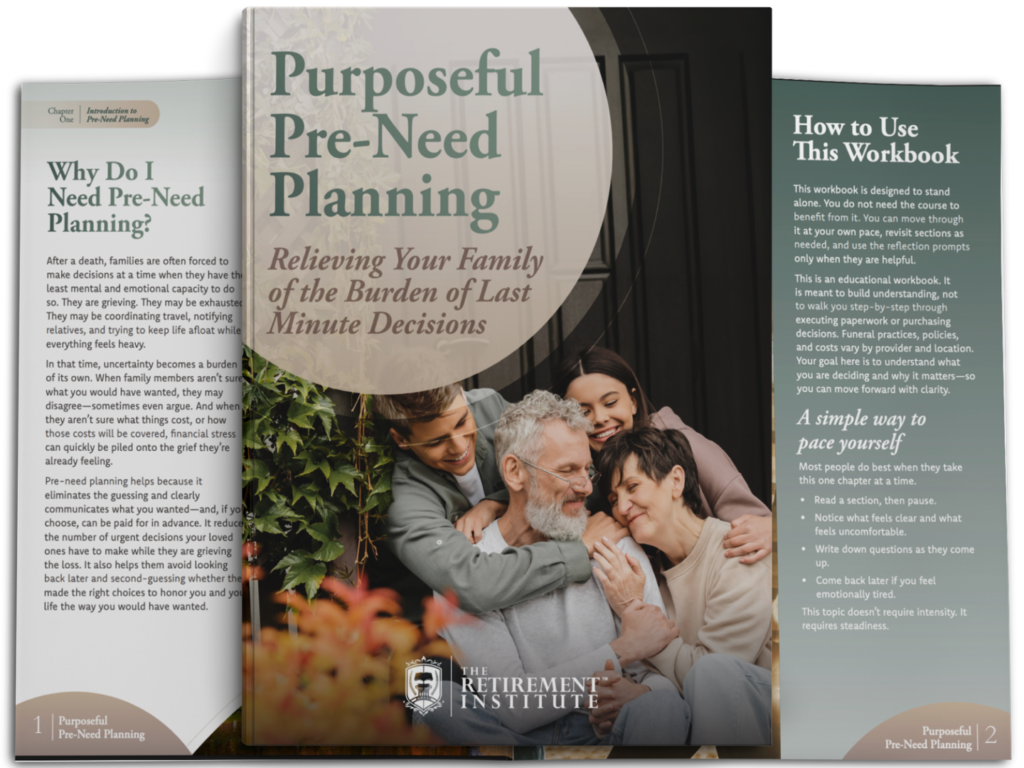
In addition to the video lessons, you’ll also receive a comprehensive Course Companion Workbook — designed to help you move from passive learning to active implementation. This workbook is a structured guide that walks you through exercises, prompts for reflection, and practical worksheets aligned with each lesson — helping you organize financial information, clarify your priorities, and document key decisions as you go.
By the end of the course, you won’t just have new knowledge — you’ll have written answers, organized information, and a clearer picture and personal roadmap. The workbook becomes a working document you can revisit, refine, and share with your spouse, family or advisor — turning insight into something actionable.
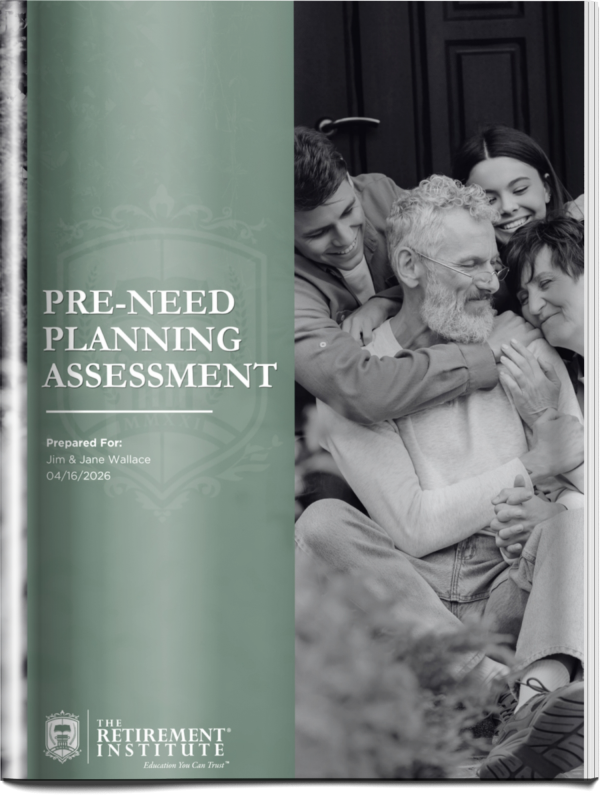

A comprehensive diagnostic tool designed to give you clarity across each core area of retirement planning. This guided assessment walks you step-by-step through income planning, tax planning, healthcare preparation, longevity planning, investment considerations, estate planning, and more.
Instead of guessing where you stand, you’ll receive personalized scores in each category — allowing you to see clearly where you’re “on track”, and which areas may benefit from additional attention, including where small adjustments could create meaningful improvement. Most importantly, you’ll receive thoughtful next steps tailored to each area, so you’re not left guessing — but with practical direction. The goal is simple, clarity and awareness. Because once you can see your full financial picture objectively, you can move forward with far greater confidence.


Included when you enroll is access to our 24/7 on-demand support team— so your questions don’t have to wait. Retirement planning often raises thoughts or questions as you progress through each lesson. Questions like,
“How does this apply to me?”
“What if my situation is slightly different?”
Instead of letting uncertainty linger, you can ask for clarification in the moment. Whether you need help understanding a concept, thinking through a scenario, or navigating next steps, support is always available when you need it. The goal isn’t to replace personalized planning — it’s to ensure you’re never left with unanswered questions and that you feel supported along the way.

By Danielle Bermeister, Pre-Need Planning Specialist at The Retirement Institute
Dear Friend,
Let’s speak honestly about a conversation most families actively avoid. If you are like the families I speak with every day, you have spent decades working, saving, and planning.
You have insured your home, your health, and your life. You’ve likely told your children, “When my time comes, just keep it simple.”
You might assume that because you have a life insurance policy and keep money in a checking account, that your family will be fine. You might believe that your loved ones know you well enough to handle the details when the time comes.
But I grew up inside a funeral home that my parents owned. And I have spent my entire career watching what actually happens to families who rely on those assumptions.
What I have seen is not the peaceful, unified grieving process that you would want for your family. Instead, I have watched exhausted, heartbroken children sit around a conference table on the worst day of their lives, completely overwhelmed by a system and decisions they have never had to make before.
When the loss of a loved one occurs, the inevitability of the funeral industry takes over immediately. This is what we call an “at-need” arrangement, meaning no plans were made prior to the death.
And in an at-need situation, your family unfortunately does not get to take a break from making decisions to grieve. Instead, within hours of finding out they’ve lost you, they are handed a massive price list and clipboard.
They are then asked to make upwards of 150 specific decisions over the span of just a few days.
When you tell your family to “just keep it simple,” you’re unintentionally making it anything but simple for them. You are simply transferring the weight of those 150+ decisions onto them to make at the exact moment their “decision-maker” is broken by grief.
The emotional toll of an at-need arrangement is devastating, but the financial consequences are equally severe.
Funerals cost thousands of dollars. And when families are forced to make quick financial decisions while grieving, two tragic things tend to happen.
First, and most often, they emotionally overspend. They feel guilty. And because they love you so much, they feel like they need to prove their love for you through the amount they spend.
They end up purchasing upgrades they don’t need, often putting the entire cost on high-interest credit cards because they don’t have the liquid cash readily available.
“But wait,” you might say. “I have a life insurance policy to cover this.” But here’s the often overlooked challenge you rarely hear about until it’s too late: To get access to your life insurance proceeds, your family must first present a death certificate.
And in many states, acquiring an official death certificate can take up to and sometimes more than 60 days. Life insurance companies are unable to release a single dollar until that paperwork is processed.
Yet, the funeral home requires payment upfront. Meanwhile your family is left to foot the bill out of their own pockets, accruing debt and arguing over who should pay for what while they wait months for your life insurance to clear.
Alternatively, families also sometimes emotionally underspend. They are so distraught that they just want the process over with. As a result they choose the absolute bare minimum, skipping a service entirely.
Months later, they find themselves in the produce aisle of the local grocery store, running into an old friend who asks, “How is your mom doing?” Suddenly, they are forced to process their grief all over again, explaining that you passed away months ago and there was no service.
They realize too late that in a rush to move through the process and decisions quickly they shortchanged the very event designed to help them heal, honor your life, and say goodbye.
When there are no written instructions, grief results in otherwise rational adults fiercely arguing for what they believe you would have wanted.
I once listened to two sisters engaged in a shouting match in our funeral home conference room. The argument was not over an inheritance. It was over whether to serve cookies or bars at their grandmother’s reception. Both were entirely convinced they knew what their grandmother would have wanted.
Another family I know of had six brothers, together they had to plan their mother’s funeral without any of her wishes documented ahead of time. The disagreements in that room became so intense, and the feelings so hurt, that it was years before those six men could stand to be in the same room together again.
This unfortunately is the greatest cost of leaving your final arrangements to chance. You don’t just leave behind memories.
You leave behind decisions. And if you do not make those decisions ahead of time, you risk leaving behind a legacy of fractured family relationships.
It’s not fun to think about, but it is an unfortunate reality that plays out in funeral homes across the country every day.
The good news is, you have the power to ensure your family isn’t one of them.
You can eliminate the guesswork. Eliminate the financial stress. And ensure that when the time comes, your family does not have to endure the stress and financial burden, but instead, focus on grieving and supporting one another.
This is the power of Purposeful Pre-Need Planning. When you plan in advance, you get to make your wishes known.
You get to set up the proper funding vehicles so the money is available when it’s needed, within 24 to 48 hours, completely bypassing the delays of waiting on death certificates and paperwork.
Most importantly, you give your family the ultimate gift: the space to grieve, to heal, and to celebrate your life without the burden and weight of logistics.

At The Retirement Institute, we believe you deserve to get educated on and make these deeply personal decisions from the comfort of your own home. That is why we created the Purposeful Pre-Need Planning Course.
A highly practical, step-by-step educational guide that walks you through the exact process we’ve used over the past two decades to help thousands of families make these important decisions. Throughout the course we will break down the 150 decisions into four manageable categories:
Normally, the tuition for this course is $197. However, because you just took the crucial first step by ordering your copy of our book, we’d like to offer you a one-time Educational Scholarship.
When you enroll on this page today, you will receive lifetime access to the Purposeful Pre-Need Planning course, the Companion Workbook, and access to our 24/7 Planning Support Team, all for just $97.
As you’ll learn throughout the course, Pre-need planning is much less about death, and more about leaving a gift for your loved ones, those who love and depend on you most. the people who will survive you.
It is your way of looking at your family and saying, “I have taken care of this for you. You don’t have to guess. You don’t have to stress. You just have to be together and support one another.”
Don’t leave your family to navigate the stress of an at-need arrangement. Click below to take advantage of your Educational Scholarship, and enroll in Purposeful Pre-Need Planning today, and give your family the gift making your wishes known.
Warmly,
Danielle Bermeister
Pre-Need Planning Specialist
The Retirement Institute
P.S. While we all assume we “have time” to plan later, none of us knows how long we really have. Every day you wait is a day your family remains exposed to the web of decisions they are unprepared to make on your behalf.
Secure your lifetime access to the course now, take advantage of the opportunity to save $100, and replace uncertainty with the peace of mind of knowing it’s all taken care of.

The emotional toll of an at-need arrangement is devastating, but the financial consequences are equally severe.
Funerals cost thousands of dollars. And when families are forced to make quick financial decisions while grieving, two tragic things tend to happen.
First, and most often, they emotionally overspend. They feel guilty. And because they love you so much, they feel like they need to prove their love for you through the amount they spend.
They end up purchasing upgrades they don’t need, often putting the entire cost on high-interest credit cards because they don’t have the liquid cash readily available.
“But wait,” you might say. “I have a life insurance policy to cover this.” But here’s the often overlooked challenge you rarely hear about until it’s too late: To get access to your life insurance proceeds, your family must first present a death certificate.
And in many states, acquiring an official death certificate can take up to and sometimes more than 60 days. Life insurance companies are unable to release a single dollar until that paperwork is processed.
Yet, the funeral home requires payment upfront. Meanwhile your family is left to foot the bill out of their own pockets, accruing debt and arguing over who should pay for what while they wait months for your life insurance to clear.
Alternatively, families also sometimes emotionally underspend. They are so distraught that they just want the process over with. As a result they choose the absolute bare minimum, skipping a service entirely.
Months later, they find themselves in the produce aisle of the local grocery store, running into an old friend who asks, “How is your mom doing?” Suddenly, they are forced to process their grief all over again, explaining that you passed away months ago and there was no service.
They realize too late that in a rush to move through the process and decisions quickly they shortchanged the very event designed to help them heal, honor your life, and say goodbye.


“I’ve managed our household finances for most of our marriage, but I never felt confident about long-term financial decisions, especially when it came to investing. This course gave me the clarity I needed to feel capable — not overwhelmed.”
“As a widow, I’ve often felt like I was catching up on decisions I didn’t fully understand before. This course helped me slow down, learn at my own pace, and regain a sense of control. I finished the course feeling more confident instead of anxious.”
“Love the course workbook. Really helpful exercises that walked me through clarifying what I actually want retirement to look like — not just what I think it’s supposed to look like. I still refer back to it when I need a refresher.”
“I didn’t realize how differently retirement planning affects women until I took this course. I’ve attended a few dinner seminars in the past, but none that addressed women’s issues like longevity, income gaps, or the possibility of outliving a spouse the way this course did. It helped me see the landscape clearly — and plan for it thoughtfully.”
“This course really opened my eyes to the longevity issue we face as women. Arwen walked through this calmly and practically. It didn’t feel overwhelming — it felt manageable. And now I know I need to re-evalute my previous plans to ensure they will last to my full life expectancy”
“For the first time, I feel like I can participate confidently in conversations about our retirement plans. I’m no longer just sitting quietly hoping everything works out. I now better understand the moving pieces, and that understanding brings real peace of mind.”
“I thought I had a good handle on retirement. What I hadn’t considered were the healthcare and long-term care realities women face. The way Arwen explained it though didn’t create fear — it just helped me know how to think about it and plan for it.”
“What I really appreciated about the instructor was her tone. She didn’t assume I should already know everything, and she didn’t talk down to me either. She simply explained the decisions ahead in a way that made sense to me. Probably helped that she was a woman too!”
“The chat support team was a pleasant surprise. Anytime I had a question, I received really thoughtful responses — not like most chat services I’ve used. I probably kept Grace talking longer than she was supposed to, but I appreciate the time she spent with me.”
Danielle Burmeister is a Pre-Need Planning Educator with more than 20 years of experience helping individuals and families as they think through end-of-life planning. She understands that this isn’t an easy topic—but does an excellent job making it feel more approachable, without overwhelming.
With a strong background in pre-need planning, family guidance, funeral service, and legacy planning, Danielle helps families focus on what matters most, bringing a sense of clarity to choices that can otherwise feel overwhelming. In the Purposeful Pre-Need Planning course, Danielle guides viewers through creating a plan that reflects their values while also helping protect loved ones from the emotional and financial burden that can come with having to make last-minute decisions. Her approach is warm, genuine, and guided by the belief that proactive planning now can spare loved ones a lot of stress later.

Reach out to us at support@theretirementinstitute.com
Yes — this course was created for anyone who would rather make these decisions thoughtfully now than leave them to family in the first days after a loss. Whether you’re planning for yourself or helping an aging parent, this was built to make an uncomfortable subject manageable.
That’s the narrow version, and it’s a small part of what the course covers. Pre-need planning is about documenting your wishes, understanding which decisions your family would otherwise face under time pressure and grief, and choosing which of them you’d rather settle yourself. Some of it involves arrangements. A great deal of it is simply writing things down while there’s no pressure to.
In practice it often isn’t. Families routinely discover they remember different conversations, or that the person who knew the wishes isn’t the person the funeral home needs to speak with, or that nobody knows where anything is kept. The decisions get made in a compressed window by people who are grieving. This course walks through what actually gets asked and when, so your family isn’t guessing.
Most people find the opposite is true. The discomfort tends to live in the avoidance rather than the planning, and families who’ve done this work describe relief rather than dread. The course approaches the subject practically and without drama — as one more thing you handle well, rather than a conversation to keep postponing.
Earlier than most people think, and while there’s no pressure to decide anything quickly. Planning done calmly and on your own schedule tends to produce different decisions than planning done in a funeral home on the worst day of someone’s life. There’s no wrong age to have your wishes written down.
Not to worry. We offer a 30-day, 100% money-back guarantee on all of our courses. Enroll today, watch the lessons, work through the material, and if at any point you decide it isn’t what you expected, simply email our support team and we’ll refund 100% of your enrollment fee. No questions asked.
This course isn’t designed to be something you skim or binge. It’s meant to help you understand the decisions that often carry long-term consequences. Many women spend far more on a single meeting, a seminar, or fixing a mistake they didn’t see coming.
We’ve priced it so it’s taken seriously — without requiring a big leap of faith. That’s also why we offer you an unconditional guarantee, so you can get started risk-free.