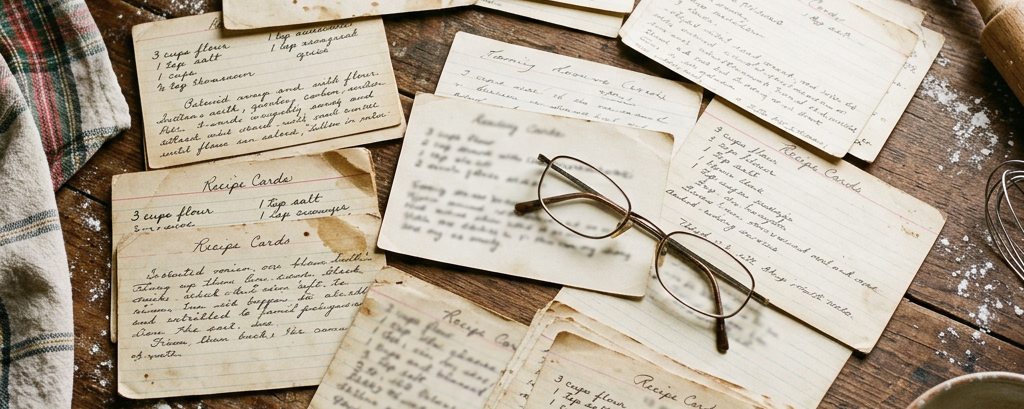
The recipe card said “a handful of flour” and nothing else. No measurement, no temperature, no time — just a handful, as though everyone’s hands were the same size and everyone’s ovens ran identically hot. That card belonged to a grandmother who never once measured anything in her life and never imagined she needed to write it down more precisely, because she assumed she’d always be the one making the bread. She wasn’t wrong about her own kitchen. She was wrong about how long her handwriting would need to keep working after she stopped being able to stand at the counter.
Most families have a version of that card somewhere — instructions that made perfect sense to the person who wrote them and almost no sense to anyone trying to follow them decades later. A family recipe book exists to solve exactly that problem, and it’s worth being honest about what the actual problem is, because it’s not really about recipes.
You’re Not Preserving Instructions. You’re Preserving a Voice.
If the goal were purely functional — reproducible food — you’d standardize every recipe into precise measurements, strip out the handwriting, and print it clean. That would produce a cookbook. It would not produce what people actually want, which is something closer to a voice recording that happens to also tell you how to make gravy. The messiness is the point. “A handful of flour” tells you something about a person that “1/3 cup all-purpose flour” never will.
This reframe changes what you should actually collect. Don’t just gather recipes — gather the handwriting itself when you can (a photographed card beats a retyped one), the story of when a dish got made and why, the family jokes attached to it (someone always burned the rolls; someone always doubled the garlic against instructions), and the corrections scrawled in the margins by whoever inherited the recipe next. Those margin notes are not clutter to clean up before publishing. They’re a second voice, in conversation with the first, and that conversation is exactly what makes a recipe book feel alive instead of laminated.
Where to Actually Start (Not With Every Recipe Ever Made)
The instinct is to collect everything — every recipe anyone in the family has ever used. Resist it. A recipe book with 200 entries, half of which nobody has made in twenty years, gets opened once and then sits on a shelf. A recipe book with the fifteen dishes that show up at every holiday, every birthday, every ordinary Tuesday that somehow became tradition — that gets used, because it maps onto the actual rhythm of the family’s life rather than an aspirational archive of it.
Ask a simple filtering question for each candidate: if this dish disappeared from the family table forever, would someone notice within a year? If yes, it belongs in the book. If the honest answer is “probably not,” it can wait for a second volume, or never make the cut at all, and that’s fine. This isn’t a museum. It’s a working document.
Recruit, Don’t Just Collect
A recipe book built by one person, alone, from what they happen to have on hand, will always be thinner than one built by asking. Call the aunt who makes the stuffing. Text the cousin who has the great-grandmother’s cookie recipe in a shoebox nobody else has seen. Most people are far more willing to hand over a family recipe, and the story behind it, than you’d expect — the asking itself often becomes a small, warm interaction that has nothing to do with cooking and everything to do with someone feeling like their contribution to the family matters enough to be recorded.
This is also where you catch the recipes that would otherwise die with a single person’s memory. If Grandpa’s chili exists only in his head and he’s the only one who’s ever made it, that recipe is one missed phone call away from being gone entirely. The recipe book, in that light, isn’t really a keepsake project. It’s a small act of urgency dressed up as a nice idea for later.
Format Matters Less Than You Think
People agonize over whether to make something polished — a printed, bound book — or something simple, like a shared folder of photographed cards. Both work. What actually determines whether the thing gets used isn’t production value; it’s accessibility. A beautifully bound book that lives in a closet gets opened at Thanksgiving and forgotten the other 364 days. A simple shared digital folder that everyone in the family can add to, from wherever they are, tends to actually grow over time instead of freezing the moment it’s finished.
A reasonable approach: start digital and simple — photographs of the actual cards, typed-out notes where handwriting is hard to read, organized by occasion rather than alphabetically, since that’s how people actually think about their own tradition. If it earns a printed version later, as a gift or an heirloom in its own right, that’s a natural second phase. Don’t let the desire for a perfect physical object be the reason the project never starts.
What the Card Actually Said, in the End
The granddaughter who inherited the “handful of flour” card didn’t standardize it. She made the bread four times, measured her own hand’s handful at roughly a third of a cup, wrote that number in pencil in the margin next to her grandmother’s ink, and left both. The recipe now works for anyone who picks it up — and it still sounds like a grandmother who never measured anything, because it still is her, mostly, with one small addition from someone who loved her enough to make sure the bread kept getting made.