Frank spent forty years running a small engine repair shop out of his garage, the kind of place where half the tools didn’t have designated spots because he knew exactly where each one was by memory. When he died, his family held the service the way the funeral home suggested: dark suits, folding chairs in rows, a slideshow set to instrumental music nobody recognized. It was respectful. It was also, everyone admitted quietly afterward, nothing like Frank. Frank would have hated the folding chairs. Frank would have wanted people standing around his garage with a beer, telling the story about the time he fixed a neighbor’s lawnmower with a coat hanger and a prayer.
Three months later, his family threw a second gathering. This one was in the garage. There was no program. There was a cooler.
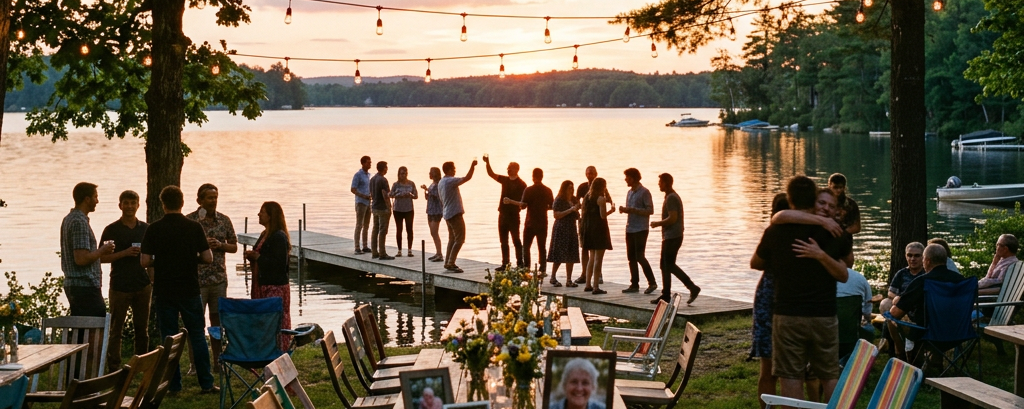
If you’ve searched “celebration of life ideas,” you’re probably picturing something closer to that second gathering, not the first one — you just don’t yet know what it’s allowed to look like. That’s the real question hiding under this search: not “what are some ideas,” but “am I actually allowed to make this feel like a party instead of a funeral, and will people think that’s disrespectful?” Short answer: yes, you’re allowed, and the people who loved that person will almost always be relieved you did.
A Celebration of Life Is a Different Event, Not a Smaller Funeral
A traditional funeral or memorial service is usually structured, often religious, and focused on mourning as a shared, formal act. A celebration of life is a different tool entirely — flexible in timing (it can happen weeks or months later), and built around the specific shape of a person’s actual life rather than a standard program. Neither format is more correct. Some families hold both, for the same person, because grief and remembrance don’t always fit inside a single event.
A funeral is often built around a script. A celebration of life is built around a person — which means the “right” format is whatever format actually matches how they lived, not a template imported wholesale from somewhere else.
Let the Location Do Some of the Work
A backyard. A favorite restaurant or neighborhood bar. A park where they walked the dog every morning for twenty years. A workshop or garage. A boat launch. A golf course clubhouse. Their actual living room, filled with the people who sat in it most often. The venue itself can do a surprising amount of the emotional work before a single word is spoken.
Give People Something to Do, Not Just Somewhere to Sit
Guests standing around a slideshow on a loop can feel passive in a way that leaves everyone a little restless and unsure what to do with their hands. Activities that mirror the person’s actual life tend to work better: a potluck built from the dishes they always made and everyone always asked for the recipe of. A “share a memory” board or open mic instead of a single formal eulogy. Releasing something small and meaningful — seeds, paper lanterns, balloons — tied to something they loved. A playlist built from music that was genuinely theirs, not generic instrumental filler chosen because it seemed appropriately solemn.
These small shifts change the whole texture of the room. A memorial that gives people a task — even a simple one, like writing a memory on an index card — tends to produce more real conversation and more real laughter than one that only gives them a chair.
The Traditions Worth Keeping, and the Ones You Can Skip
Some funeral conventions exist mostly because “that’s what you do,” not because they serve anyone particularly well. Guest books get signed once, in a hallway, by people balancing a plate of food, and then live in a drawer forever. A formal “moment of silence” always seems to land at either four seconds or four excruciating minutes, with no reliable way to predict which.
Keep the traditions that genuinely serve remembrance — a photo display, a structured way to share memories, a quieter corner for anyone who needs a break from the noise. Skip the ones that only exist because skipping them feels unfamiliar. Unfamiliar isn’t the same as disrespectful.
It’s Okay If People Laugh
Some families worry, quietly, that laughter at a memorial gathering signals disrespect — that grief is only being honored correctly if the room stays solemn throughout. It’s worth saying plainly: laughter at a specific, true story about someone is one of the clearest signs the room actually knew and loved them. Solemn silence isn’t the only acceptable register of grief, and a room that laughs together over a story about someone is not a room that has stopped grieving them.
Frank’s garage gathering didn’t look like anything a funeral home would suggest, and that was exactly the point. Nobody there could tell you what the “correct” celebration of life format is supposed to include, because there isn’t one — there’s only the question of whether the room, for an afternoon, felt like the person it was for. Start there, and the rest of it — the food, the location, the playlist — tends to sort itself out.