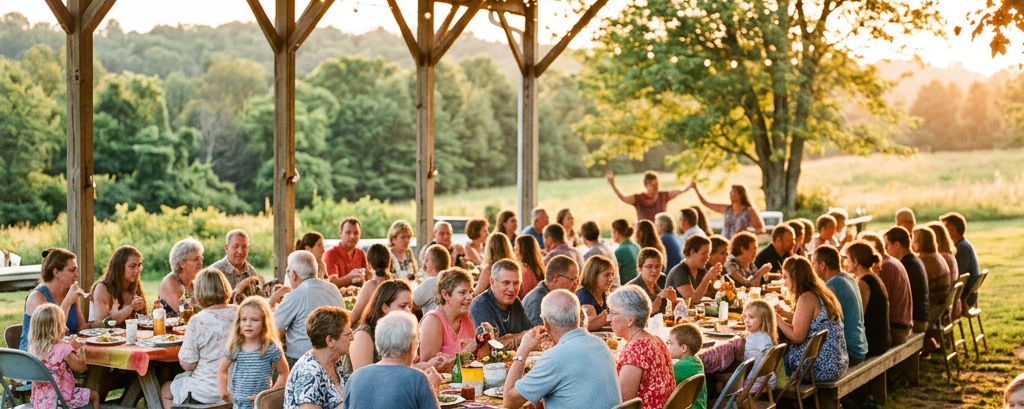
The email went out in March: family reunion, July, the usual lake house, bring a dish. By June, half the family had RSVP’d no — a soccer tournament, a work thing, a vague “we’ll try to make it” that everyone understood meant no. The aunt organizing it, for the fourth year running, found herself wondering whether the problem was the date, or the location, or whether her family had simply, quietly, stopped wanting to be a family that gathers.
It’s rarely the last one, and it’s worth saying so plainly, because that’s the fear that actually drives most of the anxiety around reunion planning — not “will the barbecue turn out okay,” but “are we still the kind of family that does this, or is that already over and nobody’s said so.” The honest answer, almost always, is that families don’t stop wanting connection. They stop attending events that ask more of them than the connection is worth.
The Assumption Worth Questioning: Bigger Isn’t Better
Most reunion planning starts from an assumption that the goal is maximum attendance — get everyone there, all fifty cousins, one big weekend, once a year. That assumption is exactly what makes reunions exhausting to plan and easy to skip. A once-a-year, everyone-required event competes against every other once-a-year, everyone-required event on fifty different calendars, and it usually loses, because a wedding or a kid’s tournament feels non-negotiable in a way a reunion doesn’t.
The reunions that actually sustain themselves over years tend to trade scale for frequency. A smaller, lower-stakes gathering three or four times a year — a Sunday cookout, a casual game night, a shared hike — builds the muscle of actually seeing each other in a way one big annual production never quite does. The annual big reunion, if you still want one, works better as a capstone on top of that ongoing rhythm than as the only structure holding the family’s connection together.
Lower the Cost of Saying Yes
Every reunion has a hidden cost that has nothing to do with money: the cost, in effort and awkwardness, of showing up. For family members who’ve drifted — the cousin nobody’s talked to in three years, the sibling who left on bad terms, the in-law who’s never quite felt like part of things — that cost can be high enough to make “we’ll try to make it” the easier answer every time.
You can lower that cost directly. Give people a specific, small job rather than a vague invitation — “can you bring the potato salad” gets a different response than “hope you can make it,” because a job creates a reason to show up that isn’t purely social risk. Build in an easy exit — a defined end time, rather than an open-ended “stay as long as you like” that can feel like it demands an entire day. And reach out to the people most likely to feel like the invitation doesn’t really apply to them, personally and specifically, rather than trusting a group text to do that work. A direct “we’d really love to see you this year” does something a mass email cannot.
Structure Beats Hoping People Will Mingle
Left unstructured, a reunion tends to sort itself into the same small clusters every year — the same people talking to the people they already talk to, while the family members who most need reconnecting stand at the edges. A little bit of structure counteracts this without making the whole day feel programmed. A simple shared activity that mixes generations — a cornhole tournament, a group cooking project, a scavenger hunt built around family trivia — gives people something to do together that isn’t just standing around trying to make conversation, which is often the actual barrier for anyone who’s been away a while.
One structural addition worth considering deliberately: a moment, even a brief one, for someone older in the family to tell a story the younger generation hasn’t heard. This does double duty — it gives the gathering a sense of purpose beyond food and small talk, and it’s one of the few settings left where that kind of story naturally gets passed down at all.
What Actually Makes People Come Back
The reunions people show up to year after year rarely succeed because of the venue or the menu. They succeed because attending them felt good enough, the last time, to be worth doing again — low pressure, genuine connection, an actual sense of having been missed rather than merely invited. That’s a harder thing to plan for than a potluck sign-up sheet, but it’s the thing actually worth planning for.
The aunt at the lake house scaled back the following year — smaller, one afternoon instead of a full weekend, a simple cookout instead of an elaborate spread, personal texts instead of a mass email. Attendance went up, not down. Nobody had stopped wanting to be a family that gathers. They’d just needed gathering to cost less than it had.