
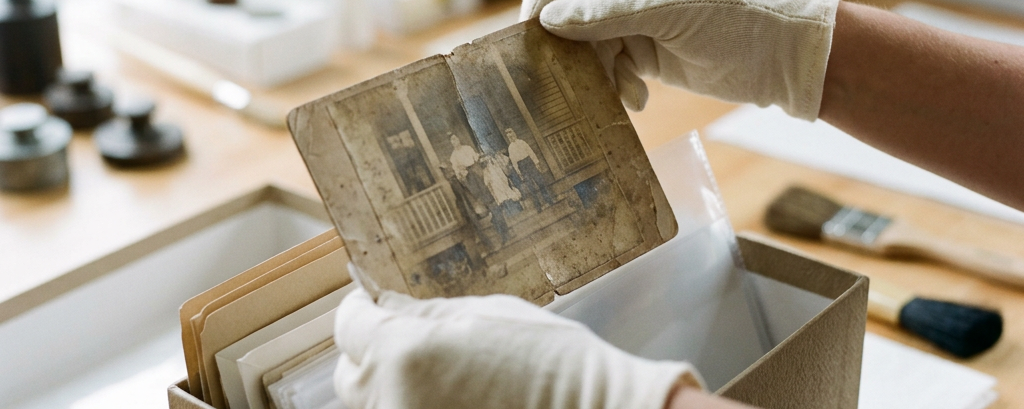
A shoebox of photographs survived a house fire once, mostly by accident — it happened to be in a closet the flames didn’t reach. The family that owned it treated the survival as a small miracle, and for years afterward kept the box exactly where it was, in the same closet, as if moving it might undo the luck. It took a flood two decades later, one that did reach that closet, to teach them the actual lesson: the photographs hadn’t survived because they were protected. They’d survived because they got lucky, once, and luck is not a preservation strategy.
The Real Threat Isn’t Theft or Fire — It’s Time
Most people worry about losing old photos to a dramatic event — a fire, a flood, a move gone wrong. The bigger, quieter threat is simple chemical decay. Photographic prints fade, yellow, and become brittle from ordinary exposure to light, heat, and humidity, whether or not anything dramatic ever happens to them. A box of photographs sitting untouched in an attic for thirty years doesn’t need a disaster to become damaged — it just needs thirty ordinary years.
Digitizing Is the Single Highest-Leverage Thing You Can Do
If you do nothing else, scan the photographs. A digital copy doesn’t fade, doesn’t yellow, and can be duplicated infinitely across devices and family members, which means a single house fire or flood can no longer be the difference between a memory existing and not existing. You don’t need professional equipment — a flatbed scanner or even a well-lit phone photograph of each print, done carefully, is dramatically better than leaving the only copy sitting in a box. Do this before you do any other preservation step, because it’s the one that actually removes the single point of failure.
Store the Originals Like They’re Worth Something — Because They Are
Once digitized, the physical originals still deserve real care, both for their own sake and because a scan is never quite the same as holding the actual print someone once held. Store them in acid-free, archival-quality boxes or albums rather than the magnetic “sticky” albums common in past decades, which chemically damage photos over time. Keep them away from direct sunlight, basements, and attics — anywhere with significant temperature or humidity swings — and handle prints by the edges rather than the image surface, since skin oils accelerate deterioration.
Label Now, While Someone Still Can
This is the step people skip most often, and the one that matters most for the story rather than the object. A photograph without names, dates, or context becomes, within two generations, a picture of strangers — technically preserved, functionally lost. While someone who remembers is still around, go through the box with them and write names and approximate dates on the back in pencil, or in a caption alongside the digital scan. The image survives either way. Whether anyone knows who’s in it depends entirely on whether this step happens in time.
The family with the shoebox eventually scanned all of it — several hundred photographs, an afternoon’s work spread across a few weekends — and stored the originals properly for the first time in decades. The flood that came for that closet years later took the box itself. It didn’t take a single photograph. Those had already been safe for years, sitting in a folder that had never once depended on luck.