
There’s a particular kind of house that feels less like a home and more like a memorial — every shelf crowded with inherited china, every wall hung with someone else’s portraits, every surface reserved for something that can’t be touched, moved, or used. It usually happens gradually, one inherited box at a time, until the person living there realizes they’re a guest in a house full of other people’s memories, with barely any room left for their own.
The instinct to display everything you’ve inherited comes from a good place — honoring the people the objects belonged to. But displaying everything usually honors nothing well, because a room crowded with fifty meaningful objects makes it impossible to actually notice any one of them. Curation isn’t a betrayal of the people who left these things behind. It’s often the only way to actually see them again.
Pick a Few Things to Actually Feature
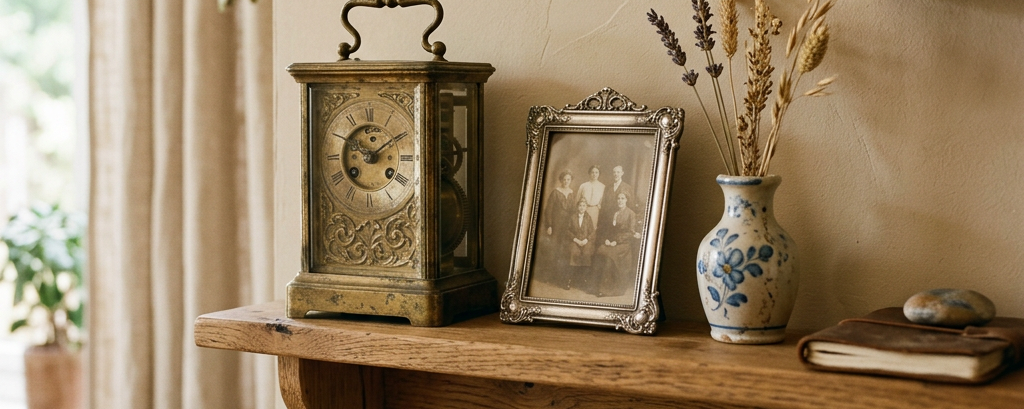
Instead of displaying everything you’ve inherited, choose a small number — three to six objects — to give real, deliberate placement: a clear shelf, good light, maybe a small card or plaque with a sentence about who it belonged to and why it mattered. Everything else gets stored properly, not because it matters less, but because a few well-placed objects with room to breathe carry more presence than fifty crowded together competing for attention. This isn’t about ranking whose memory matters more. It’s about giving any of them the chance to actually be seen.
Rotate Instead of Accumulate
A useful practice borrowed from actual museums: rotate what’s on display rather than trying to show everything permanently. Keep a rotating shelf or cabinet, and swap out what’s featured every few months or around specific occasions — a parent’s favorite season, an anniversary, a holiday they especially loved. This does two things: it keeps your home from becoming visually overwhelmed, and it means objects that have been in storage get their moment again instead of being permanently retired to a back shelf that everyone eventually stops noticing.
Let Function Be a Form of Display
Not every heirloom needs a shelf. Some of the most meaningful ways to keep an object present are functional rather than decorative — using a grandmother’s mixing bowl for actual baking, keeping a grandfather’s watch wound and worn rather than boxed, serving dinner on inherited dishes on ordinary Tuesdays instead of reserving them for occasions that come once a year. An object in active use is, in its own way, more honored than one behind glass — it’s still doing what it was always for, which is often exactly what the person who owned it would have wanted.
The goal was never to build a shrine. It was to keep a person’s presence woven into an ordinary life, in a way that feels warm rather than heavy. A house with three carefully placed heirlooms and room to breathe usually honors its history better than one crowded wall to wall — because in the second house, everything is competing for the attention that, in the first, a few objects actually get to keep.