
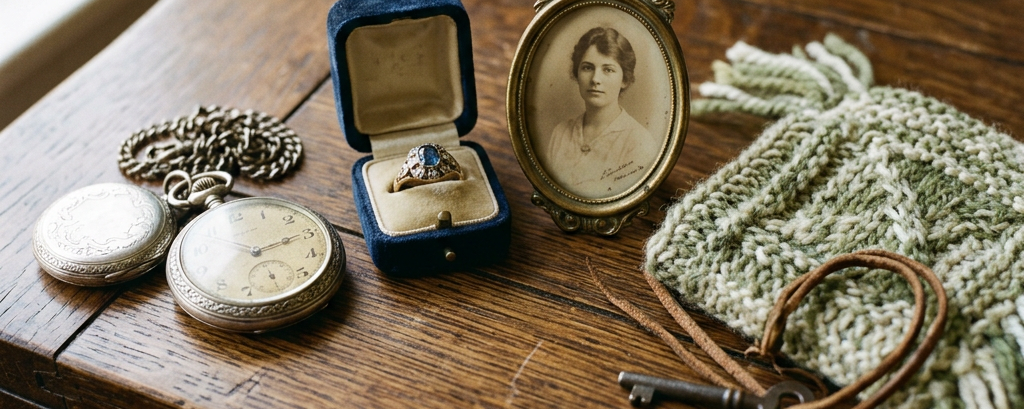
A woman once asked an estate appraiser to value her late father’s toolbox — not because she thought it was worth anything, but because she needed permission to call it an heirloom instead of just an old box of tools taking up space in the garage. The appraiser told her, honestly, it was worth about sixty dollars at auction. She kept it anyway, and years later admitted the appraisal hadn’t actually settled the question for her at all. It had just proven that the question she was asking — what’s it worth — was never the one she actually needed answered.
The Definition Most People Get Wrong
The common assumption is that an heirloom is defined by monetary or antique value — the good china, the diamond ring, something an appraiser would take seriously. That’s a real category of object, but it’s not the same category most people mean when they say “family heirloom” in an emotional sense. An heirloom, in the sense that actually matters to most families, is any object that carries a person’s presence forward — something they used, made, chose, or were simply known for — regardless of what it would fetch at auction. A sixty-dollar toolbox that a father used every single Saturday for thirty years often carries more of him than a piece of jewelry he never once touched.
Three Honest Categories
It helps to separate what you’re holding into three rough types, because each deserves different treatment. There are objects of real financial value — these deserve appraisal, insurance, and a clear-eyed conversation with family about who gets them and why, since money attached to inheritance has a way of surfacing old tensions if it’s left ambiguous. There are objects of pure sentimental value — no market worth at all, but carrying a story or a memory that matters, like the toolbox. And there are objects that are simply old — inherited by default, kept out of guilt or habit, without a story or a use attached to them at all. That third category is the one people most often mistake for the second, and it’s worth being honest about which one you’re actually holding.
The Question That Actually Sorts Them
When you’re not sure which category something falls into, ask: can I say, right now, without straining, why this mattered to the person who had it? If the answer comes easily — he used it every Saturday, she wore it to every holiday, it was the thing he was known for — it’s a real heirloom, regardless of value. If you have to think hard and still come up empty, it may simply be an old object that happened to survive, and it’s fine to let those go without guilt. Not everything that outlives a person needs to outlive you too.
The toolbox is still in that woman’s garage. She uses two of the tools from it regularly now — a hammer, a level — which is, in its own way, exactly what her father would have wanted from it. Not a museum piece. A tool, still doing what it was always for, in the hands of someone who remembers where it came from.