
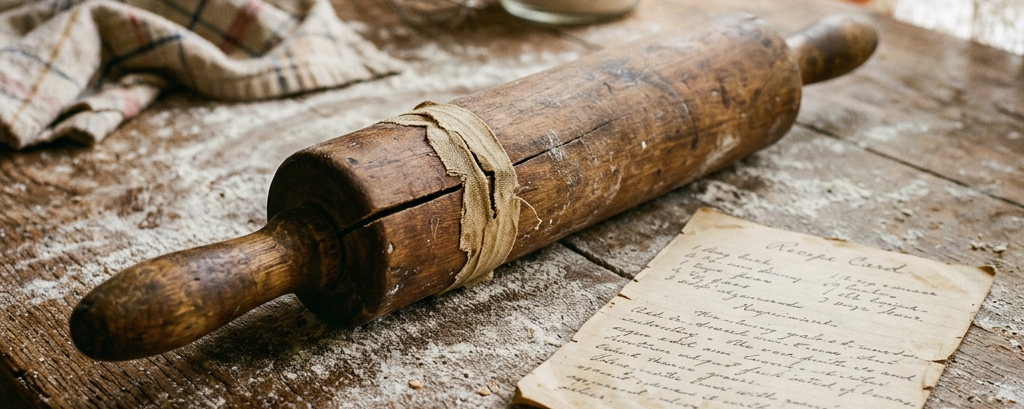
The rolling pin sat in a drawer for eleven years before anyone used it again. It had belonged to Carol’s mother, who’d used it every Thanksgiving for four decades to roll out a pie crust nobody could quite replicate — thin at the edges, thick enough in the middle to hold the filling, cracked slightly down one side from a fall in 1987 that her mother had patched with a strip of kitchen tape and refused to throw away. When Carol’s mother died, the rolling pin went into a box, and the box went into a drawer, because Carol didn’t know what else to do with a piece of wood that meant everything and, on paper, was worth about four dollars.
That gap — between what a thing is worth and what it’s worth — is the whole subject of this piece. Most people inherit at least one object like Carol’s rolling pin: not the china, not the jewelry, not anything an appraiser would linger over, but something small and specific that carries a person the way nothing else does. And most people have no idea what to actually do with it beyond keeping it in a drawer and feeling vaguely guilty every time they see it.
What Actually Makes Something an Heirloom
Here’s the assumption worth naming out loud: an heirloom is not defined by value. It’s defined by use — by the fact that someone touched it, repeatedly, in the ordinary course of being alive, and that touch left a residue no replacement object can carry. A grandmother’s wedding ring is an heirloom because of what it represents. A grandmother’s chipped mixing bowl is an heirloom because of what it did — every birthday cake, every batch of cookies, every Sunday dinner it quietly made possible. The ring gets insured. The bowl gets used, and using it is the whole point.
This distinction matters because it changes what you’re actually deciding when you’re deciding what to keep. If you’re sorting a parent’s belongings and asking “is this worth anything,” you’re asking the wrong question — or at least an incomplete one. The better question is: did this object do something? Did it show up, again and again, in the specific texture of this person’s life? A tool they used daily will often carry more of them than a keepsake they set aside for special occasions and rarely touched.
The Fear Nobody Says Out Loud
Here’s what’s actually underneath the question of what to keep: will anyone want this after me? It’s an uncomfortable thing to sit with, because it turns the object into a referendum on whether your family’s story continues — and if the honest answer is “maybe not,” that can feel like a small failure, or a small grief, layered on top of whatever grief already got you here.
It helps to separate two different questions that tend to get tangled together: what should I keep, and what should I preserve. Keeping is physical — space, dust, the practical reality that you cannot keep everything and neither can the next generation. Preserving is about making sure the story attached to the object doesn’t die with the object, or with you. You can preserve a story you don’t keep. You can photograph the rolling pin, write down the Thanksgiving-crust story on the back of the photo, and give the physical object to a cousin who bakes, or donate it, or let it go — and the thing that actually mattered, the story, survives intact.
This reframe tends to relieve more pressure than any organizing system. You are not the last line of defense for every object your family has ever touched. You are the last line of defense for the stories — and stories, unlike rolling pins, don’t take up drawer space.
A Simple Way to Sort, Without the Guilt
When you’re facing a house full of someone else’s life, three questions tend to cut through the noise faster than any elaborate system:
Did I see this person use it, specifically, more than once? An object with repeated use behind it usually carries more weight than one that sat untouched in a cabinet, regardless of what it’s made of.
Is there a story attached that I actually remember, right now, without effort? If you have to strain to recall why something mattered, it may matter less than your guilt is telling you it does.
Would a specific person’s face light up if I handed this to them? Not “would someone appreciate it” in the abstract — a specific person, a specific reaction you can picture. If you can picture it, that’s often your answer.
For the ones that pass none of these tests but still feel too heavy to release, a photograph and a written sentence or two — who owned it, what it was for, why it mattered — takes five minutes and solves the actual problem, which was never really storage. It was fear of forgetting.
What Carol Did
Carol took the rolling pin out of the drawer, photographed it — crack, tape, and all — and wrote three sentences about the Thanksgiving crust on an index card that now lives with the photo in a drawer that isn’t hidden anymore. Then she gave the rolling pin itself to her niece, who bakes every week and had, it turned out, been wanting exactly this kind of a rolling pin, and had no idea one with this particular history existed. Her niece uses it now. The crack is still there. The story about 1987 came along with it, told once, in person, the way stories are supposed to travel.
The rolling pin, in other words, went back to doing what it was always for. And the thing Carol had actually been protecting — not the wood, but the woman who used it — is safer now than it was sitting in a drawer, because it’s being told to someone new.